Showing posts with label Malabar History. Show all posts

From Krishnattam to Kathakali

Today we see it in its various avatars both in Kerala and abroad, either the capsule version or the full version. The stories have changed; you even have King Lear and Chinese stories done in this form these days, a far cry from the epics. It is greatly respected by dancers of the world and it brings in a bit of awe in the mind of the discerning viewer. Perhaps like the characterization of Keechaka by Panikkar did over a century ago, in the mind of the lovely lass Tatri. Lots of questions come up about the origins of this complex act and people even talk sometimes about the similarity with the Chinese opera or the Kabuki theatre of Japan. It is a rainy morning here, gets the grey cells going for me and so I thought it is a good idea to spend a little time and go over the legends that made it what it is today.

I still recall the sleepy nights at our temple in Pallavur, many moons ago, when we had Kathakali for the Ezham vilakku celebrations (now we have Ganamelas by winners or participants of TV shows..Nobody in the village barring a few cronies has much interest in laborious dances like the Kathakali, they seem to treasure comfortable sleep at home instead and press buttons of the remote or the keyboard to see other more appealing stuff). But in those days, the ceremonious curtain would come up around 10 PM on the small stage, held by a couple of healthy lads from the troupe and the Kathakali performance would follow on until the wee hours of the morning. The few people who understood it (very few then and even fewer now) enjoyed it and talked at length about the glory of the dancers, specific mudras and expressions, my father included. I for one had no interest then, nor much understanding of the art form itself today, but then again, the history aspect and the connotations and similarities with other dance forms interested me enough to take up the subject and study it briefly. The knowledgeable people wax eloquently at length on the dress, the makeup and the artistes as well as their awesome skills. They talk about comparable performances and other artistes long gone, including the great Kavungal Sankara Panikkar.

But before we get to all of that, we have to look at a less popular art form to which Kathakali owes its origins, namely Krishnnattam…Ah – a lovely song by S Janaki comes to my lips…ente makan krishnan unni, krishnattathinu pokumbol…krishnattatinu poyal pora, Krishnan ayi theerenam..Anyway to get to the point, i.e. understand Kathakali better, one has to know about its origins in Krishnattam, so let us start there.

The medieval periods in Kerala witnessed the development of various ‘attam’ or dance forms where temples witnessed expert players use the form to tell a story to the witnessing public with a sonorous singer intoning the story from an epic– the first form of playback singing (not so in koodiyattam). There were various types in vogue, like the Chakiar Koothu, Koodiyattam, Nangiar koothu, Kamsanatakam and Meenakshi natakam, all of which were very popular in the Palghat Shornur areas. By this time frame, Jayadeva’s Geeta Govinda from North India had found its way south. One avid fan of it was the Zamorin of Calicut Manaveda Thampuran. Recall that the Zamorins had one of the three names, Manavedan, Manavikraman and Virarayan, and this was the Zamorin born about 1595.

As the caste system had already taken its roots, Sanskrit which was spoken by nobility kind of stood at the top of the languages tree, as the language of the gods, and was the language used by learned Vidwans and nobles like the Zamorins when discussing art or devotional issues. Here a legend takes over and as we know, remains as the large story that envelopes some small fact. We are now way back in the Malayalam year 829 or Gregorian year 1653-54 AD.

Manaveda was in his late middle years was more interested in temples and art. Times were not like it was for his ancestors who had to battle the Portuguese and many others… Manavedan who was deeply religious was a great devotee of Lord Krishna of Guruvayoor and lived and administered Malabar from Guruvayoor and not Calicut, departing from norms.

This particular legends starts at Guruvayoor, the Zamorin Manavedan was with his friend and great philosopher Vilwamangalanm Swamiyar who had this special connection with the lord, for he could see him whenever he wanted, or so it seems, for one does not quite question legends. Manavedan of course had this overwhelming desire to see the lord too and pestered Vilwamanagalam relentlessly, and finally Vilwamanagalam after checking with Lord Krishna said that he could arrange the event. Accordingly the lord would appear in the courtyard of the temple, near the Elanji tree and as promised, he did as the little boy Krishna. Manaveda was overcome and rushed to embrace the little lord in his excitement. Krishna looked at Vilwamangalam and curtly said ‘you did not tell me that this was to happen’ and disappeared, but during the embrace, Manavedan was left with one peacock feather in his hand, which was from the head-tuft of Krishna.

The Zamorin Manavedan was distraught and wanted to atone his discourtesy to the lord. That was how he came about writing the entire Krishna Geethi, a poem in Sanskrit set in eight cantos. He also vowed to make a headgear and install the lord’s feather in it and dedicate both the poem and the dance drama to the lord. He then selected a dance troupe, choreographed the dances and had it played over 9 nights at Guruvayoor. Thus came about the art form called Krishnattam, performed only by the Zamorin’s troupe at Guruvayoor and at selected locations, mainly temples. The dance had a flowing style, more like what is known as lasya bhava, romantic and lyrical. In older days, the performance was even offered as a vazhipadu by wealthy patrons.

People may ask – what happened to Manavadean? He became the Zamorin in 1655 and reigned 1655-58, breathing his last in Trichur. As mentioned earlier, he was Zamorin only for a short period 1655 A.D to 1658 A.D governing from Guruvayoor. He built a palace at Guruvayur and shifted his administrative offices to Guruvayur. But it appears he passed away at Trichur as he was preparing for a war with the Dutch and his body was brought to Guruvayoor and cremated in the palace premises (now a statue stands over the location).. As VS Iyer explains, ‘It is significant that when Krishnanattam performances at Guruvayur temple used to be concluded with a last show at the Zamorin's palace there, the stage was made to face the south - for the author to witness the performances - a direction which is considered inauspicious and invariably avoided wherever the play is staged elsewhere.’ Perhaps he was touched by Narayaneeyam composed around the same time, and the Bhagavatham, after having been influenced by Geeta Govind and Bharata champu. Anyway every 30th of Malayalam month of Thulam is celebrated at Guruvayoor as Krishnageethi dinam. One aspect to be borne in mind is that Manavedan was no dance expert and was perhaps trained and assisted by the great koothu master Anayath Krishna Pisahraody at Thiruvegapuura near Pattambi. Today you can see paintings of the scene where Manadevan meets Lord Krishna on the walls of the temple in Guruvayoor. (Curious indeed that the Zamorin has his hair tuft all wrong, it was always worn in the traditional way, not as depicted in the painting). It also popularized the beautiful sopana sangeetham tradition, songs sung at the temple steps to the beat of the edakka (the chenda is never used, it is not appropriate).

There are differences of opinion about the exact period when Krishnageeti was transformed into Krishnanattam and about the process of transformation. Ezhuthachan (though he and Poonthanam wrote in Malayalam), Melpattur and Cherussery were also inspirations in the creation, without much doubt. As PKS Raja a later Zamorin explains, ‘Originally the performance of Krishnattam was strictly restricted to the Guruvayur Temple, palaces of the members of the Zamorin's family, temples and houses of Namboodiri Brahmins within the jurisdiction of the Zamorin's empire. Performances outside the jurisdiction of Zamorin were strictly prohibited. Also the Zamorins used to take the original headgear prepared by Manavedan Zamorin along with them when they went out on important occasions, particularly when they went to fight with the neighboring rulers. But this (head gear) was lost at the time of invasion of Hyder Ali’. The Zamorin mostly adopted the costumes, facial make up and mudras from Koodiyattam. While the music in both Koodiyattam and Krishnagiti are in Sanskrit, there is a difference in performance. In Koodiyattam, the actors themselves recite slokas, while the slokas in Krishnattam are recited by expert musicians in the background. While there are Ragas and Thalas in Krishnagiti, there is no formal raga sense in Koodiyattam. Historians are of the opinion that the earlier form Ashtapadiyattam was introduced by a Zamorin, prior to the era of Manavedan Zamorin, so perhaps the next Manaveda perfected it as Krishnattam and propagated it further with the legend..

KK Gopalakrishnan explains about the intricacies in his Hindu article- Krishnageeti was composed in 1654 before the era of the trinity of Carnatic music. In fact, it was during the period of Venkitamahi who introduced the 72 melakartas in Carnatic music. The ragas and talas used in “Krishnageeti” thus clearly point to the existence of a strong musical tradition in Kerala. Though nobody knows how exactly “Krishnageeti” was sung in its formative years, there is every reason to believe that it was in the style of sopana sangeetam. Subsequently, when Krishnanattam evolved, characters were given definite shapes and make-up was prescribed according to the existing rules.


A Krishnanattam performance is basically different from Kathakali, which uses hand and facial gestures and follows padartha abhinaya, the literal interpretation of the verses. Krishnanattam is more dance-oriented with intricate and aesthetic patterns. There is an old saying that to appreciate Kathakali one has to observe the actor’s face and for Krishnanattam the audience must carefully watch the actor’s footsteps. This speaks volumes about the peculiarities of the two forms.

And now that we have exhausted the legend behind krishnattam, the divine art form or offering to the lord of Guruvayoor, we get to the even more interesting legend behind the origin of Kathakali.

But before that take heed to this age old Malayalam saying from Malabar

Krishnattam kaanan kulikkanam, kathaikali kandal kulikkanam…

which means you have to take a bath to see Krishnaatam, whereas you have a take a bath if you see a Kathakalai performance (perhaps owing to the inherent impurities in that art form..)…well, I am sure the Kathakali connoisseur is livid, and so I have to hasten to explain that Krishnattam was considered an offering of the faithful whereas the Kathakali was an art form created for the common man’s enjoyment, never as an offering to the lord. But then, there was an intermediate stage when Kathakali was actually called Ramanattam and was more Bhakti inclined..

It all started with a misunderstanding. Now we move away from the suzerain the Zamorin at Calicut, to a lesser king of Venad, the Kottarakkara Thampuran 1625-1685 – named Veera Kerala Varma of Kottarakkara, a place south of Cochin, where the Elayadathu swaroopam ruled. So as we see, Krishnattam had picked up steam and was popular though practiced only in specific places. One fine day, as the story goes, the Kottarakara raja requested the Zamorin for a loan of his fine troupe, to perform at Kottarakara, perhaps for a royal wedding function. The reigning Zamorin scoffed at the idea and rejected it outright stating that the people of Kottarakara were not intelligent enough to understand krishnattam let alone host a performance or enjoy it. Obviously there must have been some friction between the families, perhaps the Kottarakara raja sided with the Dutch at that time or was more aligned to the upcoming raja of Travancore, for there were many power games going one, and some of it may be found in my articles covering the Malabar and the Dutch, so the Zamorin was getting his back at the Kottarakkara king. I would presume this was uttered by the successor of the Krishna geethi Manavedan, for the devout Zamorin would not have uttered such callous comments and secondly the authorship of Ramanattam is dated around 1660-80.

So how did the Ramanattam get created, at least in legends? The Thampuran sat on the steps of the temple pond, praying to Lord Ganesa while looking at the still waters of the pond, when a gentle breeze rippled the waters and the slanting sunlight played a medley of colors on its surface. This was apparently the inspiration behind the multiple cascading colors used in Ramanattam costumes, and well, the lyrics were written sitting under the banyan tree…Interesting, right the similarities..Krishna and the Elanji tree at Guruvayoor, the Banyan tree and Ganesha at Kottarakara…Well, the first staging of the dance drama was done in front of Ganesha at the temple, and the dance steps came from another art form called Parapettam wheras the intricate body movements are said to be from kalaripayattu (this is a little strange for kalaripayattu was more prevalent in Malabar), though I am not quite in agreement with that. The language of the poetry was the Malayalam Sanskrit mix called the manipravalam style (more on that in another blog) which was better understandable to the bigger public. As time went by Kaplingad Namboothiri created the complex choreography. The original Ramanattam as you can imagine was also set around 8 cantos like Krishnattam. The first performers were a bunch of agile youths from the king’s army who were personally conducted by the king and assisted by Kittu kurup the kalari master and Venkalath Sankaranasan on their choreography. As time went by the Kottayam thampuran and many others like the Travancore kings, Iriyamman thampi and Thankachi contributed to create more themes to the Attakatha tradition.

As the legends continue, the story takes a full about turn. The new Zamorin at Calicut has heard about the development of Ramanattam and invited the troupe of the Kottayam Thampuran to perform Ramanattan at Calicut. The old animosity is forgotten and the team arrives in Calicut. One of the key performers, unbeknownst to the Zamorin was the Thampuran himself. So brilliant was the middle aged actor’s performance that the Zamorin goes up to him to congratulate him on a brilliant performance when he recognizes the Thampuran….the Zamorin finally acknowledges that the people of the South do indeed know a thing about arts…grudgingly….

Raamanaattam which was later transformed into Aattakatha, and yet later into Kathakali, described the complete story of Lord Raman. By the end of the seventeenth century, the finished product of Raamanaattam was placed before the world under the title Kathakali. The name Raman Attam now became unsuitable because of the widening thematic range, the multitude of stories and development in mudras and steps and so the name Kathakali or story-play took roots. It got to be played everywhere, as a whole or in bits and is very popular today. That is how we got to today’s Kathakali which has become a peopled form that has tabled many hundred stories using an incredible 847 mudras.

Subsequently, the spread of Kathakali worldwide started due to the personal interest of Uday Sankar and other popular dancers like Ragini Devi and Louise Lightfoot. In fact we have even a Chinese story amongst modern works; the play is based on an episode from Journey to the West, a classical novel about the adventures of the Chinese monk Sanzang who attempts to bring the Buddhist Sutras from India to China.

Finally what connection could Chinese or Japanese art forms have with Krishnattam and Ramanattam? Well, there are obviously a few connections, for people who have seen Chinese opera or kabuki say that they are somewhat similar. I have not seen it so I will pass on that issue, but I am not surprised, for we do know that the Zheng He treasure ships of 1407-1410 brought along large number of performers to Calicut. I am sure the intricate masks perhaps influenced the masks of Krishnattam. It is also possible that the flow of information went the other way from Krishnattam to China, for the mudras in Chinese opera are less developed in comparison. Also the Chinese opera uses only males just like Krishnattam though covering mainly the Mongol invasion stories. On the other hand, there had been extant attam forms in Malabar dating to the Buddhist times or even linked to Aryan stories like the Ramayana & Mahabharata. These were similar to the ones in SE Asia as well as China and Japan. Such forms found their way into Koodiyattam and koothu forms and we saw that Koodiyattam indeed influenced Krishnattam (check out kandyan Ves in Ceylon). As these were practiced by a chosen few, the forms remained largely unadultered and so we still see the similarities in parts of Asia.

And so that was a little bit about attams, especially kristnattam and kathakali where the audience sits in front of a stage without special effects and backdrops, just listening to a story being sung to a tune and watching the performers making elaborate feet and facial as well as hand movements, to tell old stories, but not speaking. They collectively transport you to the period, the personnel, events and locales of the epics or even modern stories, for a period of some 3-4 hours after which they are gone, and so is the stage while the people who watched are left to recant and recount, the events and stories in their mind for many more days. That is the mystique of today’s kathakali.

Now to the photograph on the right - That is the kathakali statue in my house, all of 4 feet in height shown in full splendor, depicting Arjuna, the third of the Pandavas. It was gifted to us by our closest friends Hari and Geetha, and this Arjuna travelled the full distance from Kottayam to Raleigh, from a place connected with Kathakali’s origin (ironically to the very house of a person somewhat connected to the Zamorins). Some days I sit and look at the statue and it connects me to a story that is slowly taking shape in my mind…Hopefully I will write it soon, when time permits…

References

1. SangeethaSabaha blogsite
2. Origin and Technique of Krishnanattam, V. Subramonia Iyer
3. Hindu article
4. Krishnageethi 
5. On Krishnattam – PKS Raja
6. Theatre and the world: performance and the politics of culture Rustom Bharucha
7. Kathakali dance-drama: where gods and demons come to play -Phillip B. Zarrilli
8. The Social history of India – SN Sadasivan
9. The Ramayana in Kathakali dance drama - Nagendra Kr Singh, David Bolland

Notes.

- Kathakali is all about makeup, actions or mudras and facial expressions. To really appreciate the makeup and preparations which take many hours, you should see this video.

- One of the persons who spent his post middle years on the study and appreciation of Kathakali was none other than David Bolland who came to Calicut in 1950 to work for Pierce Leslie. He was so enamored with the art that he spent his later years and money and created such a collection of video and archival material. His books are also testament to his interest in the subject. I will cover him later in a separate article, and Bolland Sayip is still well known to the people of Calicut, at least some of the older ones.

- This article was briefly edited after it was first posted - i had made an erroneous statement in para 5 and connected the role of Tipu in Malabar and the English to this story without a second thought. My mistake and thanks to Vijay an avid reader for spotting it right away...


pics - hindu and sangeethasabha BS, thanks

Canterbury Week at Calicut

There have been plenty of Englishmen over the years, especially towards the start of the 20th century, narrating mostly interesting, sometimes short but usually tall tales of Calicut, depending on or for that matter directly proportional to the number of mugs of beer they have ingested. A large number of them, and you will recognize many a name in the annals of Malabar history, came to India not as part of the East India Company or as soldiers or administrators, but as planters and businessmen. Many of them spent years in the salubrious hilly Wynaad region not so far of Calicut, working in what we know as ‘the estates. I myself was born near one of them and my parents spent some of their happiest years in those estates’. As a child and all through the years when my father was alive, I have seen that gleam of happiness as the topic of discussion veered off to the estates and he slid back in his mind to the hills on the Ghats bordering Mysore & Tamilnadu, where he worked as a doctor. Be it Mango range, Chundale, Hassan, Murugali, Ripon, Anamalai or Talapuzha, he used to tell us about the clubs and the British and their way of life. I myself recall seeing tennis courts and billiards tables and for that matter a club with a bar for the first time where all the officers lounged after a good game. But let me not reminiscence, and get to the point which is a little about a most curious festival named the Canterbury week in Calicut. Two things drew me into the story, one the background provided by S Muthiah in the Hindu (I really enjoy reading his articles now and then) and second of course my own love for cricket. The game still catches India by the throat whenever it is played and though India is not doing well at all down under, there is always hope in the mind of the Indian cricket fan that the in the mind of the modern day Indian gladiators fighting away in the bowls where hundreds of thousands watch, the core animal instinct will take over and India will win those snarling fights between bat and ball, the slangers and the slanged…

But before we get to the planters and estates in Wynad & Calicut, we should get a feel for what Canterbury week itself is… There is none better than the article by Patrick Collins to get the real feel of it in Kent, and you can find it in the Shorter Wisden 2011 – a collection of articles, but I will give you short idea of it as the text and prose go by…

As you can imagine, this is held in Canterbury which is in the beautiful county of Kent in Britain, famed for a lovely cathedral and also an annual cricket festival, first held in 1842, during which period cricket consisting of two matches with Kent was played daily on the St. Lawrence Ground, the head-quarters of the Kent County Cricket Club. They also have more festive activities like a ladies day where hats and fashion are exhibited and pretty lassies like Bonnie (in black) in the picture below win the contest(2011) while a lot of interested men wander around and gape or ogle… As somebody said, the week of all weeks in the cricketing season is this, annually held in August on the St. Lawrence ground at Canterbury. As a Cricket County gathering of all classes, from Peer to Peasant, it never had an equal, and as a Cricket week played out by the most eminent Amateurs and Professionals in the country, it is far away beyond rivalry.

Of course cricket is the main fare – and it is only in England and its erstwhile colonies of the past that the attack and defense of three stumps becomes sufficiently popular to attract massive crowds and people marvel at the two weapons (and their wielders), the small wooden bat and a smaller ball fondly called the cherry that can at times, break your skull if not properly attired. But I will not meander about explaining the rules of the game, and will only pity those who do not know of or understand this otherwise splendid way of spending a large amount of time doing nothing but exercising the mind and eyes…As an oldtimer CB wrote - Eminently sociable, and unlike many other sports in which strength and dexterity are twin essentials, it requires no special qualifications, either mental or physical, while it possesses the merit of promoting the friendly intercourse of all classes—an object which becomes more and more practical as civilisation advances…. And as Charles dickens said in his periodical ‘All the year round’ - The cricketer's life is certainly the most purely enjoyable which any young man could lead. Is there any week in England, or in the world, like the Canterbury week? It is of course overcrowded with amusements of every kind—balls, dinners, private theatricals, and what not……..

So the Canterbury week, continuing in the words of CB (Field Quarterly 1870) was………. So far back as 1840 the ancient city of Canterbury became the nucleus of Kentish cricket. At that time thousands of persons visited the Beverley ground to witness the exploits of the chieftains of England, and, truth to speak, better elevens and more satisfactory matches were never produced. The "Canterbury week " soon became "a great fact," and, in addition to sports in the sunshine, something was deemed necessary to beguile the evening hours, and for this purpose "a company ", chiefly brethren of the bat was formed, and thus the cricket and theatrical element were agreeably embodied. From these sources of amusement others sprang, and for nearly thirty years their popularity has suffered no eclipse. In fact, Canterbury is never seen to greater advantage than on occasions like “the week." Its silence is in a special sense broken by the footstep of the antiquarian; no city is richer in historical memories, and a grand array of remarkable events suggested by crumbling monuments meet the eye at every turn. The St. Lawrence Ground is unsurpassed by beauty of situation, a rich carpet of turf, as refreshing to the eye of the spectator as pleasing to that of the cricketer, ample in its means of support and judgment of disposal, and always honoured by a large sprinkle of soft-eyed beauties grouped under commodious tents or the sylvan shade of many a wide-spreading tree.

The week was started in 1842 as a proposal by one Lord Bessborough and Sir Henry de Bathe and Sir Charles Taylor ( no clue who these personnel were), and they went on to suggest that to meet the expenses, there should be side activities like fairs and balls..Mr Collins attested in his article that the event rather than the cricket provided greater amusement, as you may have read already.

Well, the British came to Malabar, then they ruled over it and pretty soon the planters came and soon after there was a gold rush which I wrote about earlier. The early British planters found a special situation, very different from Kent, Malabar of course had a lot of lush foliage; good soil, right planting temperature and weather all right, but also unwelcome pests like mosquitoes, wild animals (elephants, tigers and the such) and torrential rain during the monsoon period. As they went around planting rubber, tea, coffee and so on, they also found ways to have a bit of amusement both in the hills and the plain of Calicut which was some 30 miles away.

As a gentleman of the time puts it - John Bull brought his idiosyncrasies to Malabar too, specifically Calicut in this case, which is his love for Cricket. And what better than to have a Canterbury week in Calicut? Thus came about the CW during the 1870’s and was conducted with regularity through 1920 where Calicut hosted the Canterbury week. More specific information of the event itself is presently scarce and anybody who can provide more dope is welcome to email me.

So as the lean period came by, the planters took some days off and came down the ghats to Calicut to spend a week on fun and frolic, perhaps on the MCC, Mananchira and Zamorin’s school grounds of those days as they stayed in the club off the beach front. The week was aptly called the ‘Canterbury week of Calicut’. The only difference was that while the Kent Canterbury week welcomed a mixing of higher and lower class people of the period, the one in Calicut was primarily for the British gentry…but then again it is a time long gone…we will not get political about this now…

Cricket was played often at Calicut and many a fixture graced the MCC grounds. WKM Langley, writing about the early days of cricket in the hills says, The Wynaad-Calicut annual fixture, always played in Calicut, was started in 1910. But the big event in Calicut was always the Canterbury week. They had a cricket match of course, horse racing, a dance ball and a fair. All this except the cricket itself is depicted in the picture below (click to enlarge)


The pictures tell the story, they show hat clad Englishmen coming to the Planters club on the Calicut Beach early in the morning, riding the bullock cart through the night, and of course with many ladies and the pomp, they have to look their best so the first call of the day is to get their hair cut (look at the guy’s hair sticking out) and barbers are pulled out of their beds, struggling. Looking at the picture - makes me a little confused as to whether the artist was really in Calicut, for that kind of a Chaprasi and barber dress is unusual for Calicut, but perhaps it was so.

Cut to another scene where you find bare bodied people scrubbing and polishing the wooden dance floor and getting the punkah rope right for the evening functions and dances, perhaps at the beach club, not so far from the MCC or Mananchira grounds. The painting as such is more focused on the horse race where obviously betting is the norm and horses are well prepared, their hoofs pared to get the regulation height right and smart looking with the right tail length and so on..You can see games like the man in the tub where you take a shy at his head and he ducks in time. But still the onlookers, mainly the locals do not look attired as in Calicut, so it is possible that the artist made this sketch without seeing the scene, but hearing descriptions from another. And in the final picture you can see more carts rushing to the horse race location, and the carts certainly look interesting though of non Calicut extract. But it provides you ample options for creating an imaginary scene in your mind. Juxtapose it with the annual exhibitions in Calicut and you will feel the right ambience..

The brief write-up says, “John Bull, as everyone knows, is fond of transporting his insular amusements to every part of the globe, frigid or torrid, whither business summons him; and so we find an imitation “Canterbury Week” established in a town only eleven degrees from the equator. There is a gay time in Calicut once a year during the slack season, when the coffee planters on the Wynaad Hills have no work to do, and are waiting for their crops to ripen. Then they all congregate in Calicut and for one week only make the most of their time by having races, balls and other excitements.”

The Canterbury week though a jolly time was not without its dark moments, there is of course the story of Ramaswamay Chetty, a well to do ICS employee, the first native covenanted civilian, assistant magistrate of Palghat (story recounted by Isaac Tyrell in his Antipodes) who was virtually British in manners and actions, food and religion, after being educated there, possibly having lost caste after going to England, and living like a Brit. At Palghat the local British did not take kindly to a native acting English and made his life miserable, but he managed to get along eventually. Unfortunately it continued and he was snubbed at the Calicut Canterbury week by a planter and this was perhaps the last straw, for Chetty perhaps decided to take his own life( or so they said), and he was found dead, shot in the head after a last day of frolic.

But well, much more cricket was played in Calicut in those days and EA Cowdrey used to play for Calicut and Wynad. EAC was of course the father of the illustrious M Colin Cowdrey about whom Cricket buffs are well aware of and R Guha had written about. Colin as you may know was born in Bangalore, EAC had the boys delivery arranged in a Bangalore hospital and not in Chundale, for he wanted better medical attention for his wife.

References
Historic alleys – The Malabar Gold Rush
S Muthiah articles 1 & 2
Picture from Graphic June 15, 1889 , Check here for larger sections

A little about John Bull – Who was he?

Some people might wonder who the John Bull I mentioned is. Well like Uncle Sam personifies USA, John Bull personifies Britain. I will borrow further text from Wikipedia to explain - He is usually depicted as a stout, middle-aged, country dwelling, jolly, matter-of-fact man. Starting in the 1760s, Bull was portrayed as an Anglo-Saxon country dweller.He is almost always depicted in a buff-coloured waistcoat and a simple frock coat (in the past Navy blue, but more recently with the Union Jack colours). Britannia, or a lion, is sometimes used as an alternative in some editorial cartoons.

As a literary figure, John Bull is well-intentioned, frustrated, full of common sense, and entirely of native country stock. Unlike Uncle Sam later, he is not a figure of authority but rather a yeoman who prefers his small beer and domestic peace, possessed of neither patriarchal power nor heroic defiance. He also wears a low topper (sometimes called a John Bull topper) on his head and is often accompanied by a bulldog… he is a plain, downright, matter-of-fact fellow, with much less of poetry about him than rich prose. There is little of romance in his nature, but a vast deal of a strong natural feeling. He excels in humour more than in wit; is jolly rather than gay; melancholy rather than morose; can easily be moved to a sudden tear or surprised into a broad laugh; but he loathes sentiment and has no turn for light pleasantry. He is a boon companion, if you allow him to have his humour and to talk about himself; and he will stand by a friend in a quarrel with life and purse, however soundly he may be cudgelled."

Mahabali and his story

Onam is around the corner, Mahabali the Kathapurushan, dear to all Malayalees is on his way to visit all of us. But is he really well known to us other than the brief story we have all heard since childhood? Not that I know of and everybody takes him for granted. So, I started on a trip to find out more and it certainly turned out to be an interesting trip. Starting with the mythical background of the story I went to Mahabalipuram, a place that carries his name but situated far away from Kerala. I then moved on to the Bana kingdoms of ancient times and finally circled back to Kerala through Tulunad checking out another link to the origin of Nairs. It was some trip and so let me take you to those locals, telling you the tale I learnt along the way. For all you know it may be a tall tale, but interesting anyway.


But first a bit about the origin of Naris – In my longish article that covered most of the usual stuff, I concluded thus - To summarize, the Nayars have been considered a derivative of local indigenous people with invading Aryans, have been wandering Scythins who settled down, the wandering Nagas and so on. No one theory holds forte, though from all the above, the Scythian link seems to be the near fetched one. At least that was what I felt then….

A preamble about Asuras

First we start with Aditi and Diti. Without getting into too many complications about their origins, Aditi’s children turned out to be the deavs or the godly sort and Diti’s through her lusty and untimely association with Kashyapa became the daityas or asuras. One such asura son Hiranyakashipu fathered Prahlada, who then fathered Virochana. Mahabali was born to Virochana and Viktare. Bana is Mahabali’s son and he fathers not one, but 4 crores of asuras named Nivatakavacas. So that in short establishes the lineage of Mahabali.

Mahabali

Now we have to figure out the connections between Mahabali and Kerala. Mahabali was as you know, a benevolent king of the asuras. Bali went on to succeed his grandfather as the king of the Asuras, and his reign over the realm was characterized by peace and prosperity. The churning of the oceans takes place, Mahabali takes possession of the urn of Amrut and a battle starts wherein Bali is first killed, but brought back to life by Sukracharya, after which an even fiercer battle takes place where Bali is victorious and drives out the Devas and Brahmanas. He would later expand his realm – bringing the entire world under his benevolent rule. Aditi his grand aunt is upset, since she is also the mother of all devas, and eventually becomes pregnant with Vamana after support from Kashyap and Vishnu.

Mahabali was performing the sacrificial rite of the Aswamedha Yagam on the banks of Narmada River (not in Kerala!) to go further up in life. We then get to the standard story, where Vamana appears as a Brahmin boy and in those days nobody refused anything to a Brahmin (even though Bali supposedly drove out all Brahmanas from his world). He asks for a boon to Bali who agrees to provide it. Vamans’s request was "You need not give me anything great. It is enough if you give me that extent of land covered by three footsteps of mine".

Despite the warnings of his advisor Sukracharya, Bali granted this boon. Vamana then grew to an immense size, and, with his first pace, traversed the all of the earth and the underworld. With his second pace, he covered Heaven in its entirety. Admitting defeat and seeing that Vamana has no more room for his last step Bali offered his own head for the third step. Vamana then pushes him into Patala or the nether world, thus saving the Devas and Indra whose position Bali would otherwise have taken.

Mahabali and Kerala

Bali was thus banished to the underworld. Due to his selfless devotion and unwavering dharma he was granted permission to visit his subjects once every year. The story also explains that the beautiful state of Kerala was the original kingdom of the Bali. We get a further clue now that Thrikkakara was supposed to have been the capital of the legendary Emperor. After Mahabalai was dismissed to Patala, the idol of Vamana was installed on the ruins of the palace of Mahabali by Saint Kapila, and he later asked the rulers of Kerala, to accept the supremacy of the deity cementing in the Brahmanism brought by Parasurama . It was a case of a Saivite defeated by Vasihnavite perhaps, looking at how the events went by, for as you know that was a tussle between them going on in the Southern parts of India. This is the only link I could find in the old tales connecting Mahabali and Kerala. But was he ever in Thrikkakara? Also if Kerala was a prosperous land that existed during Vamana’s time, then the Parasurama epoch and the story that he created Kerala with his flung axe is certainly incorrect, even as a myth. Now how did the tale tellers go wrong in those days? Ah! Who knows?

Mahabali and Mahabalipuram

But then, how is Mahabalipuram in Tamil Nadu associated with Mahabali? Many a book claims that Mahabalipuram was the capital of Mahabali, even today.

One stupid version of the popular story goes thus - The former name of this place ‘Mahabalipuram’ has a history. A very rude and cruel king Mahabali ruled in this place and in a fierce battle king Mahabali was killed by Lord Vishnu and the place was named after the dead, arrogant king Mahabali (hrrump…..who would name the place after an evil & dead king?). Max Mueller however stated - If we went to Sadras, a place near Madras, we might see that the palace of king Bali is now lying under the sea. Vamana is equivalent to Trivikrama, which again means the sun-god. Bali denotes "offering in a worship." This is a physical truth; God is as a dwarf before the offerings in His worship, or else the act of worship cannot be exalted. It is a spiritual truth. The allegory consists in the expression of these two truths. That the once flourishing Mahabalipuram is today in the nether regions, that is to say, at the bottom of the sea is, however, a historical fact.

This Pallavanadu is far removed from Cheranadu and Kerala, so how could Bali have been in both places? Time to go there I suppose, to investigate.. and so we move on to the land of the seven pagodas, in Mahabalipuram, mamallapuram or city of mahamalla. What could be the truer myth behind Mahabalipuram? The famed collection of McKenzie manuscripts provide the answer

In early times one named Mallesudu ruled here prosperously; but from refusing to feed a Brahman, and mocking him, he was, by the said Brahman, caused to be metamorphosed into an alligator. A rishi, named Pandarica, going to pluck a lotus flower from the tank wherein the alligator was, it laid hold of him, and the rishi drew the alligator, on to the the bank. The king thus obtained release, and went to Swarga: and the rishi thought to present the flower to Vishnu; but the sea refusing to give him way, he occupied himself in baling out the sea; and, while so occupied, Vishnu, in the shape of an aged Brahman, approached, and asked for boiled rice. After some explanation he engaged to do the rishi's work, while the latter should go to prepare rice. By taking up a single handful of water, the sea retreated an Indian mile (1 ½ English); and when the rishi returned he found the Brahman reposing, in the manner in which statues of Vishnu are sometimes represented. He now recognized the god; and a fane was built by him over the spot. This was kept in order, by many later persons. Before the said incarnation of Vishnu, the place was called Mallapuri and Mallapurickshetram, from the before-mentioned Mallesudu. In subsequent times the name was altered to Mahavalipuram. Those ignorant of the Sthala puranam hence inferred that Maha Bali Chakraverti ruled here, and hence called the place Mahabalipuram, and some term it Mavalipuram. Both of these names are erroneous; and are known to be so from the local puranam. This is included in the Brahmanda-purana, from the 93d adhyaya to the 100th inclusive. The names of the subsequent rulers are unknown to any one.

Tamil scholars like KV Raman rubbish the Mahabali legend of Mahabalipuram stating that the legend of Mallai was Sanskritaized to Mahabalipuram and the legend of the fallen Mahabali dovetailed into it in the most artificial manner…So let us agree with that and keep him in Kerala for now.

Mahabali and the Banas

But then let us look at the son of Mahabali to trace the father’s steps. Mahabali’s son was Bana, who created the Bana kingdom (Bana was later cut to size by Siva, 998 of his hands were loped off– now recall that the Saivite Mahabali was trounced by Vamana or Vishnu and once out of Kerala, Bana was taken to task by Siva). The Bana kingdom ‘balikula nadu’ was apparently located in (The Tamils claim that he lived in Vanapuram (Banapuram) near Perumbana padi in N Arcot and provide the story of the fight between Banasura and Anirudha –see South Indian shrines: P. V. Jagadisa Ayyar for details) Central Deccan and centered in Kolar in today’s Karnataka and originally in Gudimallam near Renigunta in Chittoor Andhra Pradesh. Interestingly Gudimallam has a Siva temple called Parasurameshwara temple Hmmm…(One more coincidence – Parasurama in Deccan?).

As we saw earlier, there was no Kerala before Parasurama came and created it. So how come Mahabali ruled it? Also we note that Mahabali was offering his yagas on the Narmada River. So was he perhaps elsewhere? And did Parasurama cult bring in the story? Did the Parasurama cult (includes Namboothiris and their Akambadi nairs) start perhaps in the Bana kingdom which remembered the Bali story of their ancestors? Certainly seems farfetched, but let us see (the story becomes further confusing for Vali or Mahabali is also the founder of the Vangas of Bengal – tells you perhaps why Malayalees and Bengalis ‘sometimes’ think alike)

Anyway the Banas had a troubled history, they were allied with various dynasties and kings of the Deccan, Pallavas, Malladeva and so on till Vikramaditya Jayameru rose to fame in 800-850AD. A number of battles with Gangas & Nolambas bear testimony to their warrior culture. The last in line was Vijayabahu Vikramaditya who defeated the Cholas. Later after a defeat by the Cholas, the kingdom and the group dissolved but they were on constant move since then around 900 AD, moving to Tamil Nadu and the Vijayanagara kingdoms as administrators and governors. But did they go further south?

Some of them were possibly the Rayalaseema Mudirajas who later became the Bunts famed for their warrior skills. For those interested in studying this link, check this site.

Banas and Kerala

If you look at the Kulashekara Perumal studies, it is mentioned that later day matriarchal kings of Kerala might be Banas originating from Banavasi, the ancient Kadamba capital with Naga connections. That Banas were Naga worshippers is also mentioned in many studies. Keralolpathi says that on the request of the Namboothiris of Perinchellur (Taliparamba) the last Cheraman Perumal was a Vanipperumal and was sent by an Aryan King of Aryapura Krishnarayar (Krishna III)(939 - 967 CE) with a large Nair army 3 lakh 50 thousand strong led by General Pada Mala Nair.

And so finally we come to Banapperumal. Well, according to Keralolpatti, he was the brother of Kavirasasingha, the king of Tulunad. Looking at the Kulashekara entry in Wikipedia, Kulasekhara Alwar was the second Tamil Villavar Chera King. By the end of the first millennium the Tamil Ezhimalai king of Northernmost Kerala, was replaced by a Banapperumal who initiated Matriarchy according to Keralolpathi. The Banapperumal or Vanikula Kshatriya of Karnataka (according to Keralolpathi) might be a Vaduga, Northern Naga invader who might have founded the Kolathiri kingdom of Kolathunadu.

This Bana perumal was apparently the person who was converted to Budhism by a Chinese monk and who went to China (That is interesting, Chinese links as early as 900AD!). Looking at Perumal timelines, he was perhaps the same Cheraman perumal who converted to Islam in other stories and Christianity in some others. Anyway the point to be noted here is the word Bana from the name, not anything else.

Banapperumal, according to the Keralolpathi became the king of Kolathunadu and assumed the title Cheraman Vadakkan Perumal (rival Chera) and favoured Matriarchy indicating his Naga origins. It should however be noted in this context that the veracity of Keralolpathi as an authentic historical document is doubted by some historians and its narratives are highly pro-brahminical. However, it has also been argued that the later Naga kingdoms are not related or only partly related to the Chera kings. The later kingdoms may also be more related to the northerners who came to the Chera kingdom during the Rashtrakuta invasions of 960 A.D. Keralolpathi describes the invasion of Chera kingdom by a Banapperumal with a three and a half lakh Nair army send by Krishna Rayar(Krishna III of the Rashtrakuta Dynasty).

As we saw, Banas of Deccan seem to have some country connection to the present day inhabitants of Kerala. Both the Banas and Kerala seem to have some connection to Mahabali. So did the story of the mythical Bali come to Kerala with the Banas and their entourage? As we know stories follow cultures and people and remain with them through generations. Well, if that is indeed the case, the mythological events do seem connected to something in our part of the world. But what about Bali, where was he from originally? Somewhere near Narmada between Madhya Pradesh and coastal Gujarat or for that matter Northern Deccan? Maybe that is where we came from… Who knows? One thing is clear, the time lines of the southerly dispersion of Banas end correctly with the installation of the Bana Perumal.

Epilogue

Sutala – Bali was sent to Sultala. Sutala is one of the seven patalas. Sutala is retaliatory jealousy, the others being Atala (fear andlust), vitala (rage), talatala (mental confusion) , rasatala (selfishness), mahatala (lack of conscience) and patala (murder and malice). But according to the puranas, Bali and his people were all sent to Sutala.

According to Bhagavata Purana, it goes thus - I will give him (Bali) a place, difficult for others to attain. He shall be the Indra of Savarni Manvantara. Till then let him reside in Sutala. By my wish, the dwellers of Sutala shall have no mental or bodily pain, no fatigue, no sleepiness, no defeat and no misfortune. Bless thee, O Maharaj, go to Sutala with thy clan. Sutala is even wished for by those that dwell in Svarga. Even the Lokapalas shall not be able to overpower thee. What of others? If any Daitya does not follow thee, I will kill him by my Chakra. By all means I will preserve thee and thy followers. There you shall always find me at your door. Thy Asura nature shall be there entirely destroyed under my influence. Prahlada was also ordered by Bhagavan to accompany Bali to Sutala. So they all went to Sutala.

Are we in Sutala? You can decide by looking at the malayali psyche..

What happened to little Vamama? Well, Vamana then founded a town, called after him as Vamanapur, to the west of Bhavanrtha, on a site which was recommended by Gargar Acharya (Girnar mahatmya). Vamanpur, Vamanasthali, Vamanadham or Vanthali is nine miles south of Junagad. According to this book, Balisthan where Bali lived, is today’s Bilkha which is somewhat across Vamanpur as well. Well at least that provides a link to those who believe that Parasurama and his party come down to Kerala from Maharashtra.

Further research was becoming too complicated and meaningless for this little brain and some more potent stuff needs to be ingested to get these wild connections better understood, so I have to digress…..

Anyway, until further research proves otherwise Mahabali was our (malayali) king and Onam is our festival – so, we will continue to celebrate it with gusto, and he will visit us from Patala or Sutala, wherever he is or wherever he was from……

He must be on his way by now. Kerala is rejoicing already, people are lining up…The beverages department will start to make even more money and everybody will see heaven, at least briefly…

                                                 WISH YOU ALL A LOVELY ONAM

References

Encyclopedic Dictionary of Puranas - Parmeshwaranand (Swami)
The Madras journal of literature and science, Volume 8
The history of the Bengali language - Bijay Chandra Mazumdar
The Calcutta review, Volumes 126-127
Ancient Indian History and Civilization- Sailendra Nath Sen
Ancient India: collected essays - Sakkottai Krishnaswami Aiyangar
A study of the Bhagavata Purana- Pürnendu Narayana Sinha

Note: Dr Sankara Pillai has a different angle which can be seen here

Bachelor of Arts, Madras University 1870

BA as it was called was quite popular in the early parts of the century, and then it sort of fell by the wayside with the clamor for the 1st group, engineering, CA, medicine and management and much later Computer science, bio chemistry and so on. BA has now lost all its allure; not very many go for History and languages these days and most find it dreary and not something that would provide you a steady job or income. But well, the colleges are full and the classes go on, I believe, filling the hours and days till finally the student takes the exam and gets notified via a newspaper or something that he is a BA graduate. There is no fanfare, no great convocation ceremony like you see in other countries. The BA graduate joins as one of the teeming millions, not remembering an iota of the history or whatever he or she learnt, coz it was of no interest to the individual in the first place.

Today virtually any book of significance you can think of is translated into Malayalam. The latest Paulo Coelho or the Orhan Pamuk book can be found in the Malayalam book shops of Calicut. Everybody in Kerala reads Malayalam, can write in Malayalam and Kerala boasts 100% literacy though that is valid for Malayalam as such and not necessarily English, which by the way is also perfectly OK. But can you imagine a time when a BA 2nd language Malayalam question paper had questions about the Panchatantra, the only four part Malayalam text book available for students? Can you imagine a time when it was taught by Englishmen? These days you shudder when Udit Narayan mispronounces a string of words in a song, so how would it be when a Englishman taught you the basic of the very language?

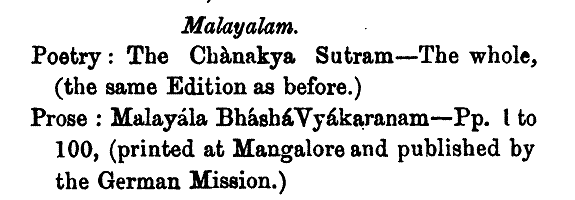
Most of you believe that the first Malayalam grammar works were by Gundert, but they were actually not. It started with a Portuguese, Dutch Malayalam dictionary in 1746, followed by a Grammar book by Surgeon Drummond in 1749. In 1839, another grammar book was written by F spring. Joseph Peet followed in 1841, and Arbuthnot followed in 1864. But all these books were in English (about Malayalam grammar) and it was only in 1868 that Gundert’s book in Malayalam was published (originally published in part in 1851). Then followed works by native speakers, like Kovunni Nedungadi, Tatchu Muttattu, Govinda Pillai and so on.. The time was thus the 1860’s. Readers must note that there were a large number of works written by native speakers before all this, from the 15th century, but I am talking about instructional books.

The Madras University was a working institution by 1840. In fact by 1855 there was even a plan to build a monster university costing over a million Pound sterling and bigger than any building in the world, but was thrown out by the supreme government as a wasteful idea. While they had a number of other subjects, the second language choice was somewhat circumspect( Hindustani, Tamil,Telugu, Malayalam). But let us now get to the details of Malayalam as offered Passages from the Panchatantra formed the syllabus for the exams. Some years later, it was slightly better, the exam covered passages from Gundert’s Keralolpatti. And thus the Parasurama cult got even more ingrained into the Malayali psyche. But can you believe that for 10 or 20 years the main stalwarts behind the Malayalam department of the Madras University comprised three Englishmen and much later two Malayalis?

To get to all this you have to go to 1858, in Madras. It was in 1858 when the EIC assets were transferred to her majesty’s British government and it was the time Guindy Engineering College was affiliated to the Madras University. The Sepoy mutiny was just about to happen. The Madras times was being published and the Poligar revolt was underway in Madras presidency.

So we are starting to see that studying in college was somewhat different a century back. Let me tell you how one went about getting a BA in the late 19th century, at for example Madras university. Now many of you may wonder why I am talking about such a strange subject. Some of you may have heard about these things from your grand or great grand parent, if they had sat through one of those examinations. But well, I learnt about all this by chance, thanks to one reader who sought help in locating and getting details on one E Marsden from the annals of history. I could not really help her too much, but I found that this individual was in Travancore and Madras, studied Malayalam, and obtained a BA from Madras University. He then went on to write a number of Malayalam text books that was in the forthcoming syllabi and made a good amount of money from selling the books. I found out also that he went back and settled in a home in England.

It so happened that I found his name as a BA graduate of 1870 passing his exams with a 2nd class. There was not a single first class graduate. That sort of got me interested. What I also found interesting was the fact that he left in posterity an address that covered three places I knew. Pembroke, Bath and Cheltenham, all places I had been to. Marsden, E., Pembroke House, Bath Road, Cheltenham - that was his address. But no further information was available on this person, other than the fact that his Malayalam text books were quite slanted in favor of the colonial government. So I left him in peace, undisturbed after a tough time in South India, in his place of eternal rest in a grave in Cheltenham UK. But I have to thank reader Sarah Stephen for triggering all this. Anyway, Marsden or his text books is not the topic, but the Malayalam course for a BA degree that one got from Madras University and the exams in Malayalam as second language in that effort.

While Gundert may have made the dictionary and moved on, the person who taught much of basic Malayalam and instilled a practice of it at a graduate and later post graduate level was a person named Liston Garthwaite. For some twenty years, he handle dteh Malayalam department in Madras University, and before him (i.e. before 1860 or so) it was Arbuthnot, though I doubt anybody took an exam in Malayalam. Garthwaite’s bio goes thus…

GARTHWAITE, LISTON, B.A. (London), late Education Department, Madras. Served from 8th April, 1857, as head master of the Zillali school, Cuddalore, of the provincial school, Calicut, and of the normal school, Cannanore, and as deputy inspector of schools; also acted as Malayan translator, and Canarese translator to government from Sept., 1869, served as inspector of schools; compiled Canarese and Malayan Arzis for the secretary of state, and also various text-books; fellow of Madras University, March, 1884; 2nd class, education department, May, 1884 ; on special duty at Madras in connection with preparation of a scheme for development of technical and scientific education, in 1884-85, and again in 1885-86; retired, Dec, 1888.

Another notable scholar who took an interest in Malayalam at that time was Mr. FW Ellis, but one of the first to get through the BA courses and become an instructor in his mother tongue was native speaker Achyutha Panickar followed by TC Poonen.

So we see that by now the basics for an institutional study of the language has been set into place. Some kind of instructors and books are available though sketchy at best. The various instructors we see from 1870-1880 are W. Joyes, Esq. L. Garthwaite & Achyuta Panikkar, JR Thomas, TC Poonen. Panikkar himself had got his BA in 1867 from Madras.

Let us look at the years 1858/1859.The single feeder schools from Malabar was the Provincial school Calicut where you a person with a good moral character sat to write the entrance exam as a 16 years old, after paying five rupees. One of the possible subjects was Malayalam and the exam was on by two books Panchatantra Part 1 and Malayalam selections ( Kottayam 1851). All you had to do was translate…Easy sentences in the two languages in which the candidate is examined shall be given for translation the one into another………….

If you entered for BA, you had subjects as follows Panchatantra Parts II-V and Bharatam. You completed three years of studies and sat for exams paying twenty five rupees.

Candidates shall be examined in each of the languages selected by them both in prose and poetry, the subject being named by the Senate two years previous to the Examination from any approved classical or standard works

Let us jump a few years and go to 1863. We find the first Prince from Travancore in the faculty, and Madhav Rao the Dewan of Travancore also listed. As I read, I saw that Hindustani exams were taught and taken in Arabic script!!

By 1864, the syllabus had expanded somewhat and Garthwaite was appointed as the Malayalam examiner. The matriculation syllabus read thus Panchatantra Part 1, Anthology 71 pages, omitting pages 58-67, Malayalam sketches of Europe & England.

For the first BA exam, they covered Keralolpatti & Nalacharita

And for the BA exam, it was


Acyutha Panikkar, Karunakara Menon, TC Poonen, etc graduated under Garthwaite’s instructions.

But it was I believe in 1865 that the first question papers and syllabus came about under Garthwaite. The question papers were partly in English and in Malayalam showing the relatively low grasp of the language, but still an admirable attempt at formalizing studies. Take a look at the question paper.


Or try this


By 1866, the syllabus increased

By this time a number of people from Malabar had started appearing and passing exams. The exams had extensive inclusions from Keralolpatti and Kerala Pazhama as well as from the Mahabharata and Ramayana and curiously, some verbose court rulings to translate.

Late into the 1870’s TC Poonen (CMS Kottayam) and V Acyutha Panikkar and one JR Thomas became examiners taking over from Garthwaite. I saw that Sarvottama Rao studied there & passed in 1867, and it was possibly his son who was my head master in Ganapati School in the late 1960’s? By 1976, Garthwaite was back. Around 1877 there was a maharaja of Cochin scholarship. In 1877 the Malayalam examiner was an RA Sheppard. And V Achyutha Panikkar was joined by R Diez and U Achyutan Nayar, and the syllabus further expanded. I could never find further details of Acyutha Panikkar, Achuyutan Nair etc, but TC Poonen is well remembered in Kottayam circles.

So that wa show it was for a person to take a Malayalam exam in the 19th century. Today you see school students cramming up what they did for a BA in those days, but remember, the problem at that time was to set a threshold and pass it. For people who had no concept of such an education system, it must have been a great challenge. Looking at them today is kind of silly, but now you know at least why Keralolpatti was given such a great significance by the previous generation and why it was and is much talked about.

There were other universities teaching Malayalam and there were schools teaching Malayalam, but this was just a peek into the Madras University’s handling of Malayalam as a subject for attaining a Bachelor of Arts. Spare a thought for people like Garthwaite and Sheppard, they toiled hard in a world alien to them, with the greatest of challenges, teaching Malayalam to a Malayali. Now I can imagine how it would have been, when the Indian teachers came to USA to teach English or Math or whatever… a few years back.

References
A progressive grammar of the Malayalam language – L Joannes Frohnmeyer
Madras university calendars 1858-1880

The King and the Dancer

Swati Tirunal, Irvivarman Thampi, Sugandhavalli ,Vadivelu, Bharatnatyam, and Mohinitattam – The fascinating connections

You may have seen a sensuous Mohiniattam by the dancer in the traditional Kerala whites and you would have seen may others in Malayalam movies and sometimes bits in a Hindi movie like dil se..but how did mohiniyattam get formulated? What has Maharaja Swati Tirunal got to do with it? What role did Violin maestro Vadivelu play in the drama and who indeed was Sugandhavalli? Those who have seen the movie Swati Tirunal would have an inkling about the tempestuous days of the young king, in fact his last happy and sad years, but let us try and take another look, for it is a story of persons, and of their simple desires in life, a story of dance, music and love and as we all know, these have a habit of coexistence, and is the formula in many a heartwarming story.

Before we get to Travancore and delve into this story, I have to start in Tanjavur, going back to a time of the renowned Dikshitar, the illustrious trio, and the musically rapturous courts of the Maratha kings. Well without getting into too much details, let me dive straight into the court rooms of the last independent Bhonsle ruler of Tanjore - Maratha Maharaja Serfoji II. The period was the late 1820’s. It was a crowning period for Carnatic music and a time when the dance form Dasiattam had finally morphed into the earliest systematic versions of a more respectable Bharatanatyam. The people who worked hard at it were the four vellalar brothers who served in Serfoji’s court, named the Tanjavur quartet comprising Chinnayya, Ponnaiyya, Shivanandam and Vadivelu. All of them had received ample training from childhood and also from the illustrious Muthuswamy Diskshitar. Chinnayya the Abhinaya guru danced himself and the first mattu pongal dances of Tamilnadu are credited to him. Sivanandam brought in the western Clarinet to the realms of Carnatic music, Vadivelu was credited (also many others like Varahapayyar and Baluswami dikshitar) with popularizing Violin in carnatic music accompaniment and Ponnayya created many famous kritis. As luck or lack thereof would have it the brothers quarreled with the King around 1830 and were promptly banished from the court due to the relationship between Serfoji and a young boy who was trained in dancing and music by Vadivelu, and due to the preference shown by the king to the boy instead of the illustrious four. It appears that the boy was felicitated during a Chittira Thiruvazha, instead of the quartet. The foursome showed their irritation by refusing to sing standing up or something of that sort. The inebriated (?) king curtailed their temple honors and that worsened the issue further, eventually resulting in their banishment.

With that, the collective creativity was destroyed and the brothers separated. They first travelled to Travancore, but Chinayya moved soon to the Mysore court of Wodeyar, Shivanandam & Ponnaiyyah returned to Tanjore after accepting Serfoji’s apologetic re-invitation, whereas Vadivelu remained in the courts of Travancore to become a friend, advisor and court musician of Swati Tirunal. With the Tanjore masters arrived a retinue of Bharatnatyam dancers and accompanying musicians plus teachers like Meruswami to enrich the carnatic music arena of Anathapuram. As history was to record, Vadivelu would remain until 1845 in the Sankara Vilasa mansion created by the king for him. His life in Travancore was mainly one of creativity and contentment though he had his fights with this king as well, but all of which ended soon due to amicable mutual respect.

What did the quartet have to do with the Bharatnatyam revival? – MKK Nayar explains - When the disintegration of the Chola, Pandya and Chera empires began, Devadasis (practicing dasiattam) were forced to seek the protection of local warlords and chieftains. As distinct from an organized society under powerful empire building kings, warlords and chieftains held sway over small principalities. Standards of law and order or morality were also totally different in the new situation. Devadasis gradually fell prey to the newly emerging carnal society and the situation deteriorated in every manner. Ultimately Dasiattam was even banned by law. It was at that time that the immortal Thanjavur quartet came like an Avatar to rescue this beautiful damsel in distress. The Tanjore Quartet organized all the basic Bharatnatyam movements of pure dance into a progressive series called Adavus. They composed new music specifically for Bharatnatyam and introduced a different sequence of items that brought out the various aspects of dance and music.


Karnatik.com adds - Vadivelu and the quartet propagated the Pandanallur style of dance (in fact, the vidwan Meenakshi Sundaram Pillai of Pandanallur is a direct descendant of the quartet!) from the traditional Sadir Natyam or Dasiattam.

The work carried out by the quartet on Bharata Natyam encouraged the young king Swati Tirunal, who now wanted Vadivelu to work on the extant but unpopular form of Mohiniattam in Kerala. Together they crafted a revival and able support was provided by two more people, Uncle Iravivarman Thampi and a lovely dusky toned dancer. I will not get into the details of Swati Tirunal and his life, but suffices to say that here was a well educated and willing student, waiting for new teachers and new ideas. The dancers knew how to convert the ideas into movements. The king however was a man in a hurry, probably he knew he had only some more years left in his life and so he wanted to experience it all, the role of a ruler, the beauty of dance and the woman’s sensuous role in it as well as the woman herself, fighting the infighting in the large royal family and keeping the colonial rulers and administrators at bay. Was there time for love in his life?

As fleeting glimpses into his life shows us, there were. Lover’s anguish, happiness and even small things like a tiff are reflected in the music and dance forms that came out of these royal courts, if you forget the arguments about authorship and other rumors for a moment. One such verse that uncle Thampi created, has this interesting backdrop and I will get to it soon, for you need to get an introduction to one more person, the centerpiece in this large real life mural, the dancer herself.

From the arid Tamil regions, the musically talented brothers who had mastered dance moved through the rough terrains in slow moving bullock carts to the fertile and coastal Chera nadu, passing the Ghats and finally arriving at Travancore. The two brothers, Vadivelu and Sivanandam, along with Nirajakshi and Satyabhama (and Mankammal – was she Neerajakshi?), and another beauty were welcomed enthusiastically by the Maharaja Swati Tirunal. The unnamed beauty, who was to become the main court dancer, would also one day, dance into the king’s heart. She was none other than the mysterious Sugandhavalli who lived in plain sight, as a royal consort, but very little is known about her even today.

I toiled hard to dredge details on her, but books and articles provide only flashing glimpses of her and her relationship with the king. Who was she? Should I make the mistake of adding flesh to the bones myself like the movie script writer of the movie Swati Tirunal did? I decided not to, for hopefully my continuing search or that of another reader will provide me more details for more complete article about her in the future, but let us try & get to know her anyway from what we have.

When somebody prohibits something, man’s interest in it is automatically roused. It could be sex, it could be alcohol, and it could be books. Well, around that time the British had decided to ban Bharatnatyam and Dasiattam, confusing the former with raunchy nautch ( the anglicized name for natch-dance) dances. Perhaps that raised the ire of Swati Tirunal, and Vadivelu after all was one of the people behind the versions of Bharatnatyam. Anyway the courts of Travancore soon marveled at the steps of the Tamil dancers and the masterly music provided by the groups that had arrived from Tanjore. It was then that the king saw her, the sensuous dancer and he thought, how it would be if she provided steps for what uncle Thampi used to talk about – the old dances of the Mohini’s, the mohiniattam (interestingly the mohinis of the Chera nadu danced only in temples, never at a patron’s home or to ones wish). Malabar had by then provided the Zamorin’s Krishanttam, the Kottayam Raja’s had popularized Kathakali, but they were serious forms, and not created to relax and sooth a person. For that you needed a Mohini and Mohiniattam, which was a form of dance the king wanted, one that was flowing, soft and sensuous. Vadivelu suggested that his young dancer would easily be able to demonstrate the steps for this based on the Sadir principles and with that the first formal years of Mohiniattam as we know it today, were created. The dancer Sugandhavalli, knew instinctively how to move to music and how she moved, for she danced straight into the young king’s heart.

What do purists say? MKK Nayar states - The origin and development of Mohiniyattam is shrouded in mystery. Though there have been legends and folklore no definite ideas are as yet available from a historian’s point of view. Some hold that it was as ancient as Chilappathikaram and Manimekala, well-known Tamil classics; a few think that it was evolved by Maharaja Swathi Thirunal in the nineteenth century. Mohiniyattam literally means the dance of the Mohini. Mohini is name of the great enchantress. By the name itself Mohiniyattam sounds seductive or erotic. As a term Mohiniyattam is found only in Kerala. Swati Tirunal and his illustrious courtiers Irayimmen Thampi and Kilimanoor Koil Thampuran (Karindran) evidently put their aesthetic heads together and produced out of the Dasiattam of the time, the refinement that is known as Mohiniyattam today. They composed many pieces for it - Swarajathis, Varnas and scores of Padas. Swathi Thirunal had the rare assistance and advice of Vadivelu of Thanjavur too. Vadivelu had just come out to Trivandrum after witnessing, and participating in the renaissance of Dasiattam into Bharatanatyam. His accounts aroused enough interest in the Maharaja to get the famous danseuse Sugandhavalli from Tanjavur. It is possible that the influence of Vadivelu and Sugandhavalli may have contributed to some movements or other in Mohiniyattam too.

Sugandhavalli – ah! The mysterious woman who enchanted the king! Who was she? The official documents certify as follows

Thanjavoor Ammachi Panapilla Amma Srimathi Sundaralakshmi Kochamma (d. 1856), née Suganda Parvathi Bayi [Sugandhavalli], a Bharatanatyam dancer who came to his court with the famous Guru Vadivelu, adopted into the Vadasseri Ammaveedu in 1843 and raised to the status of a consort or Ammachi in 1845 when the new house of Thanjavoor Ammaveedu was created for her, daughter of a mudaliyar from Tanjore.

MKK Nayar continues in the ST website - Vadivelu had come along with his sister and two other girls, one called Sugandhavally and her elder sister. Sugandhavally and her sister had their origin in south Travancore. Their ancestors had moved over to Tanjavoor a few decades earlier. There they had got Sugandhavally and her sister trained in Bharatanatyam under Vadivelu. During the presence of Vadivelu and the three girls the Maharaja got the idea of re-choreographing Mohiniyattam. A few years after the death of Sarabhi Sivanandam, Chinnayya & Ponnayya went back and Vadivelu stayed over for some more time. Nayar continues - Sugandhavally was only years old when the Maharaja took her as his second wife. She died a few years later. Vadivelu had hopes that the Maharaja would, in the re-bound, take his sister in place of Suganthavally. That was why he stayed behind. But a year later he realized that the Maharaja was no longer interested in the pleasure of the flesh. So he went back with his sister to Thanjavoor.

Author’s note - This is obviously not right as Sugandhavally outlived Swati tirunal as events were to show, a full 10-11 years.

So what was the story of Sughandavally? We glean the following from Pattom G Ramachandran Nair who wrote Thiruvanathapurathinde Ithihasam, extracts of which are reflected in Wikipedia & other books.

Sometime around 1843 Swaiti Tirunal terminated the courtship and formalized his marriage with Sundara Lakshmi Ammal, a.k.a Sugandhavalli. The Maharajah first adopted her into Vadasseri Ammaveedu, making her an Ammachi and bestowing the title of Thampi on her family members. In 1845 he constructed the Thanjavur Ammaveedu and Sugandhavalli, along with her family members resided here. The Maharajah's second wife, Thiruvattar Ammachi, whose sister was married to Uthram Thirunal as it appears did not approve of this marriage. Soon after, the Maharajah died in 1846. Legend and folklore has it that Sugandhavalli was banished from Travancore following which the Maharajah died broken hearted. However facts and records prove otherwise.

Sugandhavalli continued to live in Trivandrum at Thanjavur Ammaveedu until her own death in 1856, a full decade after the death of Swathi Thirunal, enjoying all the provisions and privileges she was entitled to as a royal consort. However soon after her death, her late husband's brother and successor, Maharajah Uthram Thirunal issued an order to attach the estate and properties that belonged to Thanjavur Ammaveedu on the ground that Sugandhavalli for whom they were made, had died. Sugandhavalli's sister Sundara Parvathi Pillai Thankachi, who had been married to Singaravelu Mudaliyar the former Alleppey District Judge, then filed a petition in Madras. The High Court of Madras in 1858 permitted the Travancore Government to attach the properties after compensating the family. Accordingly Rs. 10,000, a princely sum, was given to Sugandhavalli's family and the Thanjavur Ammaveedu taken over by the Travancore Government. The Ganapathi idol worshiped by Sugandhavalli was moved and consecrated at the Palkulangara Temple in Trivandrum. Her sister later died in 1883.

The mudaliar website adds this strange note - After Swathi Thirunal's mysterious death at an early age of 33, the Kerala Muthali community faced various threats. Then British resident, General Cullen's timely involvement helped to avert a great backlash on the community

The Thanjavur ammaveedu from the ST website- The Maharaja accepted her as a consort and the Tanjavoor Amma Veedu was constructed to house his beloved. It is a beautiful wooden building with two courtyards and elaborate wood carvings. It is believed that this house was once a place that echoed with music and dance incessantly. Sugandha Valli lured the Maharaja more and more into the world of arts and Swathi who was tired of the British dominance might have been only too glad to concentrate in his music and the dance of his beloved. But this was not acceptable to the close family members and courtesans. The forlorn Tanjavoor Amma Veedu exists even today as a store house of mysteries and stories.

Nayar continues - Although Swathi Thirunal and his courtiers made much of Mohiniyattam, it did not catch on in Kerala. That was because Swathi’s successor Uttram Thirunal was fanatically devoted to Kathakali. In his time all courtiers turned to Kathakali for gaining royal favor. At the same time in Cochin State too Kathakali had become the dominant art form. Mohiniyattam therefore travelled down to petty principalities and the dancers were forced to earn a living by disreputable means. At the end of the last century it had reached the lowest depths an art form could descend to.

Vadivelu’s story is not complete, his unhappy relatives (not his children, as he had none), by then settled in Tamil Nadu took on the legacy of the king stating that the authorship of the various krithis was actually Vadivelu’s. Some others said that many were actually done by Iryamman Thampi. I will not get into that now, it is a long and complicated subject best tackled another day.

Swati Tirunal’s short 32 year life had a sad ending. Presumably due to the pressures, the problems with the British and his Dewan, his family and so on, he had a woeful period at the end, living the life of a loner. When he died, he was virtually alone and there was no Sugandhavally to comfort him, though she was but a few miles away.

But I have to conclude by introducing another great by Thampi. So here is the legend behind and the meaning of

Prananathan Enikku nalkiya– Iraviyamman Thampi

It is a work of love with ample doses of sensuous text. As the story goes, Swati Tirunal and Sugandhavalli had a lover’s tiff, following which they did not talk to each other for some time. Sugandhavalli finally decided to ask uncle Irayivarman thanmpi for ideas to break the ice, and of course the learned man who knew his nephew very well, provided her the words below to explain her ecstasy and joy from the union between the two on an earlier occasion (to explain it in clearer words would classify this as a blog of ‘another’ sexy kind). As the story goes, she sang and danced to it and well, that broke not only the ice, but brought them together again. And as the legend goes, many more of the songs were composed by the king with her in mind like Jalaja bandhu and as it appears, the tiff with his first wife followed an insistence by the young king to have his first wife Narayani play the violin for these tunes and Sughandhavalli’s dancing. A great defense for Narayani can be read in this nice article

But back to the song (lyrics from malayalasangeetham.info)…

പ്രാണനാഥനെനിക്കു നല്‍കിയ
പരമാനന്ദരസത്തേ പറവതിനെളുതാമോ
പ്രാണനാഥന്‍....

അങ്കത്തിലിരുത്തിയെന്‍ കൊങ്കത്തടങ്ങള്‍ കര
പങ്കജം കൊണ്ടവന്‍ തലോടി
പുഞ്ചിരിപൂണ്ടു തങ്കക്കുടമെന്നെ കൊണ്ടാടി
ഗാഢം പുണര്‍ന്നും അങ്കുരിത പുളകം കലര്‍ന്നെഴു-
മെന്‍ കപോലമതിങ്കലന്‍പൊടു
തിങ്കള്‍മുഖത്തെയണച്ചധരത്തെ നുകര്‍ന്നും
പലവേലതുടര്‍ന്നും......
പ്രാണനാഥനെനിക്കു നല്‍കിയ
പരമാനന്ദരസത്തേ പറവതിനെളുതാമോ
പ്രാണനാഥന്‍....

കാന്തനോരോരോ രതികാന്തതന്ത്രത്തിലെന്റെ
പൂന്തുകിലഴിച്ചൊരു നേരം
തുടങ്ങിഞാനും മാന്താര്‍ശരക്കടലില്‍ പാരം
തന്നെ മറന്നും നീന്തി മദനഭ്രാന്തിനാലതി താന്തയായി
നിന്താന്തമങ്ങിനെ കാന്ത കൃതം
സുരതാണ്ഡമഹോത്സവഘോഷം പുനരെത്ര വിശേഷം!
പ്രാണനാഥനെനിക്കു നല്‍കിയ
പരമാനന്ദരസത്തേ പറവതിനെളുതാമോ
പ്രാണനാഥന്‍....

praana naadhanenikku nalkiya
paramaananda rasathe
paravathineluthaamo (praana)
angathil iruthiyen konga thadangal
kara pankajam kondavan thalodee (angathil)
punjiri poondu thanka kudamennu kondaadee
gaadam punarnnum angulitha pulakam
kalarnnezhumen kapolamathingal anpodu
thinkal mukhatheyanachadharathe
nukarnnum pala leela thudarnnoo(praana)

kaanthanororo rathi kaantha thanthrathilente
poonthukil azhichoru neram (kaantha)
thudangi njaanum maanthaasharakkadalil paaram
thanne marannum neenthi madanabhraanthinaalathi
thaanthayaayi nithaanthamangine kaantha krutham
sura thaantha maholsava ghosham punarethra vishesham
(praananaathan)

A link to the version by Madhuri

Notes
The origins of Monhiniattam – Nirmala Panikkar
The first reference to Mohiniyattam is in Vyavaharamala composed by Mayamangalam Narayanan Namboodri in 1709 A.D. It mentions rules to be observed regarding fees of artistes to be shared during a performance. Maharaja Kartika Tirunal Balarama Varma, author of Balarama Bharatam (1758-1798) said that the book had been written after a careful study of Lasya Tantra ( the style of the lasya dance). Travancore palace records reveal that even as early as 1801, the palace was incurring expenditure on Mohiniyattam. We also get an idea of the popularity of Mohiniyattam from the works of Kunchan Nambiar, who in his Ghoshayatra mentions Mohiniyattam in passing.There is also a reference to Mohini natana in the great treatise on the regional art forms of Kerala, Balarama Bharatam.

The Ammachi’s of Travancore
Samuel Mateer elaborates in his book - The ammachi is not a member of the royal household, and is in nowise associated with the royal court. She has neither official nor social position at Court, and cannot even be seen in public with the ruler whose wife she is. Her issues occupy the same position as herself, and the law of Malabar excludes them from all claims to public recognition.

In the case of the royal family, a number of splendid cloths are sent, and she is brought to the palace of her consort. But, unlike other Sudra unions, the Ammachi, having once been married to a Rajah, is required to remain single all the remainder of her days; and is shut up and guarded in her own residence. Hence it is not all parents that are willing to give their daughters on these terms. The bereaved lady is comfortably provided for by endowment during the life of the husband, and pension after his decease. Precisely similar is the custom in China, where, on the death of an emperor, his women are removed to a portion of the palace, in which they are shut up for the remainder of their lives.

Manu Pillai at Inorite adds - The status of the Ammachis was not always happy. Maharajah Swathi Thirunal married a lady from Kollam and invested her with the titles of Ammachi, Panapillai Amma etc. after adopting her into the Thiruvattar Ammaveedu. A few years later he was enamored of a Thanjavur dancer, known popularly as Sugandhavalli, and decided to marry her. Since she was not a Nair and was far from aristocratic, her adoption into the Vadasseri Ammaveedu was opposed and hence the Maharajah, defiantly, constructed a house for her and named it Thanjavur Ammaveedu. The first wife, known as Thiruvattar Ammachi, was put aside with little freedom.

For further details refer hyperlinked article by Manu

References
Swatitirunal Website
Yalburi afrticle - MKK Nayar

Singing the classical, voicing the modern - Amanda Weidman
Puzha article
Hindu article
Malayalasangeetham site

Older Posts Home

Related Posts Plugin for WordPress, Blogger...

Blogger Template by Blogcrowds