Showing posts with label India. Show all posts

Update: Kathakali Photo Shoot

Photo © Tewfic El-Sawy-All Rights Reserved
Last night saw one of the most intense Kathakali performances I have ever witnessed (and I have seen quite a few of those in the last few years of my traveling to India). As followers and readers of this blog know, I am leading my The Oracles of Kerala Photo Expedition/Workshop™, and a two day stop in Cheruthuruthy was planned for a photo shoot involving the performers of this ancient art form, as well as attending a private almost 2-1/2 hours performance.

The performance and the earlier 3 hours make-up session took place at the Kalatharangini Kathakali School, and I, for one, sweated so much at the intensity of it all that I had to wipe my hands continuously to be able to shoot. I almost filled 3 full 16gb CF cards during that one photo shoot which started at 3:00 pm and ended just before 9:00 pm. On top of that, I probably videoed some 20 minutes of the performance with my Canon Mark II.

We will spend most of today in class to work on our individual multimedia photo essays, since we need to catch up with that element of the workshop. With all the photography we do, we really need to set time aside to work on these projects.

I am also preparing an evening surprise for the group members, which I think they will find very interesting.

The above image is of one of the Kathakali performers, and was made with my iPhone4s.

Note: This post's actual date is March 20 as it's written in India.

Thirunakkara Utsavam Festival

Photo © Tewfic El-Sawy- All Rights Reserved
 I barely have the time to post this today since the internet connection is somewhat iffy, but the day's photo shoot was at the Mahadeva temple for the Thirunakkara Utsavam festival. This is where I spotted this family of pilgrims. I'm uncertain of which sect they belong to, but I'll find out and edit this post shortly.

Note: These are members of a family on a pilgrimage to Sabarimala Temple, some 150 kilometers from Kochi, and they're adherents of Ayyappa.

Mark Coughlan: Maha Shivatri

Photo © Mark Coughlan-All Rights Reserved

Well, I'll be on my way to India in about 24 hours...and what better way to start the trip than by featuring Mark Coughlan's Maha Shivatri's photo gallery?!

A warning though...and perhaps in time of breakfast for my US-based readers. If you have no stomach for viewing ash-smeared sadhus with their testicles lifting piles of stones. look elsewhere. For instance, Mark's Portraits Of A Saint photo gallery, which is much tamer in comparison and consists of the sadhus' portraits. Not a testicle in sight there.

Maha Shivratri is a Hindu festival celebrated every year in reverence of Lord Shiva, and in common with many Hindu religious festivals, sees pilgrims and devotees bathe at sunrise, preferably in the Ganges, and carry pots of water to the temples to bathe the Shiva "linga",  and offer prayers to the sun, Vishnu and Shiva. Unmarried women pray for a husband like Shiva, considered to be the ideal husband.

Mark Coughlan is a documentary travel photographer specializing in global social issues and world events/festivals, who traveled diverse countries such as Myanmar (Burma), Mongolia, Bangladesh, India, Nepal, China, Cambodia and Bolivia amongst others. He photographed some of the world’s greatest festivals and events including two Maha Kumbh Mela festivals (India), Maha Shivaratri (India & Nepal), and Nadam (Mongolia).

The Big Picture: Lathmar Holi

Photo © Adnan Abidi/Reuters-All Rights Reserved
I know....I've featured photographs of Lathmar Holi and of the main Holi festival a little too enthusiastically over the past few weeks, but the color is overpowering...and I'm in grey London on my way to India in a couple of days. I'm giving Holi a miss...landing in Delhi a day later, so I'm making up by posting really phenomenal photographs by Adnan Abidi, Manan Vatsyayana, and Kevin Frayer who've done a really great job of documenting this "pre-Holi Holi".

The Big Picture photo blog featured 22 of these photographs....each one better than the other.

Photo © Kevin Frayer-All Rights Reserved

MSNBC: Lathmar Holi

Photo © Manan Vatsyayana / AFP - Getty Images

I featured quite a number of posts on Holi in the past weeks, and I'm not about to stop now especially as a number of photographer friends will soon be on their way to Mathura and Rajasthan to document the festivities.

MSNBC's PhotoBlog just featured a couple of large photos of Lathmar Holi, a festival which took place yesterday, a few of days before the actual Holi celebration. It takes place at Barsana near Mathura, where people flock to celebrate the revelries.

The Lathmar Holi festival begins with a ceremony at the Radha Rani temple. The legend has it that Radha and her friends decided to teach a lesson to Krishna for stealing their clothes at a bathing ghat, and in a sort of re-enactment ceremony, the male villagers in Barsana smear themselves with colors while the women attack them with wooden sticks in response to their efforts to put color on them.

More here with Kevin Frayer's photographs. On one of these photographs, the colored water was clearly splashed on his lens!

Jim Shannon: Holi Festival

Photo © Jim Shannon-All Rights Reserved
As Holi is about to be celebrated in India (and elsewhere) in just about 10 days, and I know a number of friends are planning to attend its festivities in Vrindavan and elsewhere, I found Jim Shannon's advice and past experience to be both very valuable and sensible, and hope they will as well.

Along with the monochrome photographs of Holi by Toby Devenson (who traveled with Jim to Vrindavan) featured on this blog just yesterday, today's post will provide more than ample inspiration and guidance to those who will experience Holi for the first time.

As Jim writes in his Holi Hunters article which appears in Sidetracked magazine:
"this is one of the few times caste and wealth is forgotten. By the time everyone is covered in dye, it's impossible to tell who is rich or poor".
Jim's advice on how to photograph during Holi, especially in Vrindavan., is a must-read. I noted he photographed in the Banke Bihari temple in that holy town, but urges caution not to cause grave offense by photographing the religious deity itself. He also recommends covering one's face and arms with thick sunblock, which seemed to help in washing the dye off a little more easily. He also recommends wearing a pair of goggles to protect one's eyes from the industrial dyes.

But what about protecting one's photographic gear?? Jim and others suggest the OP/Tech Rain Sleeves which is a polyethylene sleeve made to protect an SLR camera with a lens from dust and inclement weather...and dye powder.

Jim Shannon has traveled and photographed in 42 countries, and his photographs were published by Arte Fotográfica, BBC News, BBC Countryfile Magazine, Guardian Weekend, Lonely Planet, Lonely Planet Magazine, National Geographic Traveler, The New Republic, The Observer, The Sunday Times Travel Magazine, The Daily Telegraph, Time Out, and Wanderlust, amongst others.

Toby Deveson: Holi In Monochrome

Photo © Toby Deveson-All Rights Reserved

Toby Deveson is a brave man. A brave man indeed to have considered shooting one of the most colorful festivals in India in black and white.

And if you consider his biography in which he writes "Toby Deveson has been taking photographs since 1989 when he was given an old Nikkormat and a 24mm lens. After trying a friend's darkroom he set up one of his own in a damp basement and was soon addicted to the alchemy of intoxicating smells and mysterious light. Twenty years later not much has changed. The darkroom is no longer damp but the camera and lens are the same.", you'll conclude he's a very brave photographer.

Choosing to shoot Holi in monochrome as Toby did is very unusual in this day and age. Holi is such a flamboyant festival, filled with explosions of color, that other photographers normally prefer to record its images in natural colors. The photographs on his gallery were made in the Banke Bihari temple of Vrindavan, Mathura, and in its streets.

Perhaps he chose to go against the grain, and didn't want the all powerful colors of Holi to distract the viewers away from the composition of his photographs, or from the shadow and light play or from the forms in his frames.

After all, I adopted the same rationale when I photographed the equally colorful Durga Puja festivities in Kolkata this past October. I also encouraged the participants in The Cult of Durga Photo Workshop to
produce their work in monochrome to better capture the festivities without the intrusion of color. It's a mindset.

Toby Deveson lives and works in London as stills photographer and television cameraman. He has been living in Britain since 1990 when he obtained his degree in photography, painting and music.

Teerayut Chaisarn: In Search of Sufis Movie


Teerayut Chaisarn is an emerging photojournalist/photographer from Chiang Mai in Thailand, and participated in my In Search of the Sufis of Gujarat Photo Expedition™ in January 2011. He recently completed a 14 minutes movie of his experience during the photo expedition, and posted it on YouTube.

Teerayut started photographing about 5 years ago, and is largely self-taught. He started work as a photographer on the magazine staff of his hometown, but preferred to become a freelance photographer. He also applied his Photoshop post processing expertise to assist various Thai professional photographers, and processes their portfolios.

Sufi Qawwali In India

Photo © Tewfic El-Sawy. See It Full Size On TTP's Tumblr 
"Khawaja Syed Muhammad Qutbuddin Bakhtiar Kaki, a Sufi saint, died while in a musical trance induced by a qawwali song"

And I'd say what a wonderful way to go!

Divya Dugar, a photographer and reporter for CNNGo, has just authored an interesting and valuable article on Where To Hear Qawwali In India.

Sufism has many definitions, but mainstream Islamic scholars define it as simply the name for the inner or esoteric dimension of Islam. In Sufism, especially in South Asia, the visitation of the tombs of saints, great scholars, and righteous people is a common practice.

Qawwali is a form of Sufi devotional music popular in South Asia, and is a musical tradition that stretches back more than 700 years. One of its most famous singers is the late Nusrat Fateh Ali Khan.

Divya takes us to the most famous Sufi shrines in India, and guides us to the Dargah (shrine) of Hazrat Nizamuddin Auliya in Delhi, to the neighboring Dargah Hazrat Inayat Khan, to the Dargah of Khawaja Syed Muhammad Qutbuddin Bakhtiar Kaki and finally to the most important shrine, the Dargah of Moin Uddin Chishti in Ajmer (Rajasthan).

The Delhi shrines are my favorite destinations when I'm in Delhi, especially on Thursdays and Fridays to attend the qawwali performances from local singers. The photograph featured for this post was made at the Qutbuddin shrine a few years ago, where I met a Sufi itinerant called Miskine. Extraordinarily photogenic, I found him at one of the many dhabas that surround the shrine, and made a number of photographs of him.

I've produced a number of Sufi-related galleries and audio slideshows on the Sufis. In Search of Sufis In Gujarat is a gallery of stills, while The Possessed of Mira Datar is an audio slideshow of a small shrine in Gujarat.

Travelling Lens Workshop To Ladakh...


What would you get if you mixed a troika of world-class women photographers with the visionary founder of a photojournalism workshop with an expert on Ladakh...and asked them to lead a 15 days photography workshop in a remote corner of the Indian Himalayas?

You'd get the Travelling Lens Master Class...that's what!

The Masterclass Workshop is led by Eric Beecroft (the founder of the Foundry Photojournalism Workshop) and by Varun Gupta, a photographer with first hand knowledge of Ladkah and an alum of the Foundry), with the  extraordinary talents of Andrea Bruce, Maggie Steber, and Ami Vitale as workshop instructors (they are also instructors with the Foundry Photojournalism Workshop whom I know well and respect).

As mentioned on the workshop's website, this is a journey to one of the world's most epic locations, with full access to these professionals for guidance in the participants' photography career.

The dates of the workshop are from June 21 to July 5, 2012 and the journey will include some days in Balistan, in the very heart of the Karakoram.

This is a unique opportunity of joining some of the best Foundry Photojournalism Workshop instructors, so visit the Travelling Lens Workshop website for full details.

Denis Rouvre: Sadhus

Photo © Denis Rouvre-All Rights Reserved

Absolutely gorgeous!!!

The gallery of sadhus made by portrait photographer Denis Rouvre really knocked my socks off. So many reasons for that, but readers of this blog may already know I have a fondness for chiaroscuro, and these are gorgeous exemplars of this style. The lighting, the simplicity of the poses and their 'naturalness' are additional qualities of these portraits.

To view Rouvre's Sadhus gallery on his website, click on Work. And while you're at it, you will also want to view his equally impressive gallery of Senegalese wrestlers which won the second prize in the Sports features stories at World Press Photo in 2010.

Denis Rouvre is a French portrait photographer who photographed internationally known celebrities throughout the years, and on other personal and editorial projects. His work was exhibited extensively throughout the world, and he also released several books and monographs.

Tony Smith: Kolkata's Cult of Durga (In Motion)


I'm glad Tony Smith has now produced an audio slideshow of his work during the Kolkata's Cult of Durga Photo Expedition/Workshop. The software he used to produce it is ProShow Producer, rather than SoundSlides that I normally use on my workshops. His audio slideshow is divided into chapters or segments which coincied with the different phases of the Durga Puja festival.

Tony is an Associate member of the Royal Photographic Society, and he traveled to Nepal, Bhutan, India, France, China, Spain, Morocco the USA and Canada and the West Coast of Ireland. He has attended Hindu, Christian, Muslim, Buddhist and Gypsy religious and secular festivals..

He worked quite hard during the Kolkata's Cult of Durga Photo Expedition/Workshop to produce his audio slideshow on the festival; however and much to my disappointment, he has not added to it his narrative skills which are enhanced by his precise enunciation. Perhaps that'll happen in a forthcoming iteration?

In the meantime, I suggest you view his blog entry on his experiences at the Durga Puja during the workshop, which also has a number of his photographs of the festival.

5 Weeks To 'The Oracles of Kerala' Photo Workshop

Photo © Tewfic El-Sawy-All Rights Reserved
Only 5 weeks to the start of The Oracles of Kerala Photo Expedition & Workshop™!!!

All participants flights and arrival times in Kochi (where the workshop starts) have been set, hotels rooms are booked, itinerary rejigged, and my multimedia presentations are currently being updated...

The participants in this photo expedition/workshop (7 in all, which is my ideal group size for such a workshop) are from the United States, Ireland, Bahrain and Australia...an international mix I am certain will prove to be quite interesting, since each will probably bring a varying point of view.

I am eager to start the workshop off with a couple of days of intense street photography amongst the spice godowns and alleys of old Mattencherry...The street activity of the area is a virtual live theater, with bazaar-like alleys, traditional godowns and stores stocked with all types of rice, dark brown nutmeg, red and green chillies, earthy ginger, black pepper and other spices. Not only people photography of traders, merchants, porters, but also we'll photograph details, age-old textures, peeling wall colors (or discolored) of indigo blue and ochre...etc.

I am eager to return to Mattencherry, especially after I revisit my Traders of Kochi gallery.


I mentioned Holy War before on this blog, and I am pleased it turned out to be well suited for this forthcoming adventure. It's a chronicle of Vasco Da Gama's voyages to reach the Indies; and seize its markets in spices, silks and gems from Muslim traders in Calicut and Kochi. Perfect!

Asia Society: Princes And Painters In Muhgal India


The Asia Society Museum in New York City is to show Princes and Painters in Mughal Delhi, 1707-1857, an exhibition showcasing Delhi's rich rich history of art, artists and patrons who flourished during this critical period.

The exhibition will focus on the reigns of the last four Mughal emperors — Muhammad Shah, Shah Alam II, Akbar Shah II and Bahadur Shah II Zafar. The latter emperor is the subject of William Dalrymple "The Last Mughal"...a captivating biography of Bahadur Shah Zafar, a descendant of both Genghis Khan and Timur the Great, and of the city of Delhi around the time of the Sepoy Rebellion.
The Sepoy Rebellion was eventually put down with great brutality by the British in a series of bloody battles, and Old Delhi was virtually ransacked. For those of us who know it, the Red Fort and the Jami Masjid were within a hair's breath of being razed, but were saved through the intercession of a high ranking British military commander. Imagine Old Delhi without these two architectural and historical gems?!

Bahadur Shah Zafar was sent into exile in Burma, where he died. He was banished not so much for what he did during the Rebellion, but because the Victorian Evangelicals were determined to replace his influence with that of Christianity. Zafar, having a Hindu mother, and an observant Muslim, appealed to India's major two religions and that couldn't be tolerated.

Researching the subject for this post, I read in a 2009 issue of the Telegraph that efforts were made to trace Zafar's descendants. It seems many have fled to Kolkata and Aurangabad, while others live in Burma and Pakistan.

Note to Publishers and Agents: I do not feature book reviews unless I read and like the books I write about or mention. So do not waste your time emailing me to publicize your book(s) on this blog. I will not.

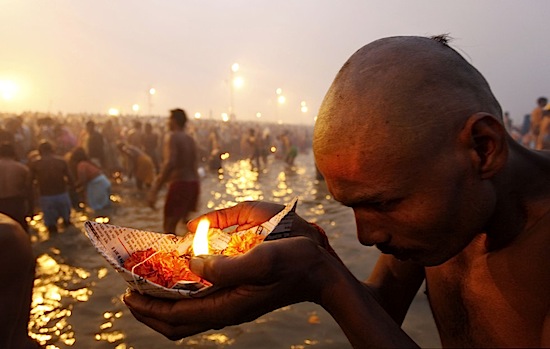
The Frame: The Magh Mela

Photo © AP / Rajesh Kumar Singh- All Rights Reserved 

The Sacramento Bee's The Frame brings us more than 30 large sized photographs of the Magh Mela.

The Magh Mela is one of the greatest annual religious pilgrimages for Hindus. In Hindu mythology, the Magh Mela's origin is said to be the beginning of the universe. It's held every year on the banks of Triveni Sangam (the confluence of the three great rivers Ganga, Yamuna and Saraswati) in Allahabad (UP).

The holy pilgrimage and festival is organized every year during the Hindu month of Magh (mid January - mid February), and is a smaller version of Kumbh Mela.

One of the photographs featured by The Frame is of the pontoon bridges that allow the pilgrims to cross to the area of the Sangam, and it reminds me (so very vividly) of my pre-dawn walks on these very same bridges during the Maha Kumbh Mela of 2001. I can still feel the sensation of being in the midst of a moving "caterpillar" of thousands of people. It was an indescribable thrill of being in such an environment with a multitude of opportunities to photograph the spectacular characters who attend such religious gatherings, that I described as "ascetics, mendicants, mystics, beggars and charlatans".

Stop a moment in sympathy at the photograph in The Frame's series in which a woman weeping as she searches for her son in the massive crowd gathering of the Magh Mela. I witnessed such scenes in 2001, and they're heart-rending. However, I was told that the majority of lost children are reunited with their families.

My Work: Kushti In Kolkata

Photo © Tewfic El-Sawy-All Rights Reserved
During my Kolkata's Cult of Durga Photo Expedition/Workshop, I chanced upon a group of traditional wrestlers near the Armenian Ghat on the Hooghly river. These were Kushti wrestlers, about to practice their sport in a small area, which was being carefully prepared for their bouts.

While I had known of Kushti being practiced in Delhi and Varanasi, I hadn't heard of it in Kolkata and after watching these wrestlers for a while, I concluded that it was different here. In contrast with the ground being moist (as in Delhi), the wrestling area (known as an akhara) here was dry, was swept with young tree branches then covered with bits of leaves, which I believe were from neighboring neem trees (which have medicinal properties).

Kushti is India's traditional wrestling, and is an ancient form of wrestling. It was held in great importance in Indian societies, but its popularity has dwindled over the years, although there are concerted efforts to revive it. Kushti practitioners face grueling daily training, a strict diet and celibacy.

The Armenian Ghat is probably the most interesting of all of Kolkata's ghats. It was built by a merchant of Armenian origin in 1724. Armenians dominated has spice in gem traders in ancient Kolkata. The Kolkata station and Ticket Reservation Room of Eastern Railways was situated in the Armenian Ghat from 1854-1874.

For those who're interested in tech stuff, I used a Leica M9 with an Elmarit 28mm 2.8.

Kolkata: Book In Progress


Photos © Tewfic El-Sawy-All Rights Reserved
A few weeks ago, I featured a poll in which I asked my readers to choose which photograph I ought to use for my work-in-progress book on Kolkata.

Out of 270 votes, 78% (or 210) chose the wide-angled photograph of a rickshaw puller because it compositionally has more depth and is more "Kolkata" location-specific, while the close-up of another rickshaw puller was deemed more attractive...presumably because he's smiling.

I have listened to my readers, and have happily gone along with the results of the poll. However, I've made a few changes; I chose a different typography and location for the book's title, and decided that the portrait of the rickshaw puller would be horizontally flipped, and be the back cover of the book.

I am currently working (taking my time, I ought to admit) on the book, choosing from the tons of photographs I returned with from my Kolkata's Cult of Durga Photo Expedition/Workshop. I am hoping that the book will be approximately 80 pages.

Kalachakra via The Big Picture

Photo © Altaf Qadri/AP-All Rights Reserved

Damn! Why haven't I been to Bodh Gaya?!!! Afer seeing these wonderful photographs of the Buddhist event in the northern state of Bihar as featured by The Big Picture, what else can I say?

Kalachakra is an ancient ritual that involves a series of prayers, meditations, dances, chants, vows and the construction of a large sand mandala - all with the aim to bring world peace. It refers to the philosophies and meditation practices contained within the Kalachakra Tantra and its many commentaries. Bodhgaya is one of the holy Buddhist pilgrimage sites where the Buddha manifested enlightenment.

In 2012, the event began on January 1 and lasted for ten days in the northern Indian state of Bihar. The present Dalai Lama has given over thirty Kalachakra initiations all over the world, and is the most prominent Kalachakra lineage holder alive today.

The Trams Of Kolkata

Photo © Tewfic El-Sawy-All Rights Reserved (Click To Enlarge)
On the penultimate day of the Kolkata's Cult of Durga Photo Expedition/Workshop this past October, some of us rode one of the famous Kolkata trams on one of its routes. As far as I recall, we chose the Esplanade to Shyambazar route, which is about 5 kilometers. Kolkata is India's only city to have a tram network, which is operated by Calcutta Tramways Company.

These are slow-moving cars, battered from many years of hard service. There are 170 trams running on the streets of Kolkata on a daily basis. The cars are single-deck articulated cars and can carry 200 passengers. When we rode ours, it was off-peak and seats were readily available.

At the Shyambazar depot (end of the line), I photographed the conductors (who were amused by my presence) in their small restroom, while they were having tea and cigarettes. I explored the idle tram cars and photographed inside the cars. The engine was made in Japan by Fuji Electric. All my exploration and photographing was observed by one of the conductors seen in the photo above.

I haven't decided yet if I ought to produce a photo gallery of the Kolkata tram "project"...perhaps an audio slideshow since I managed to record some great audio of the traffic, the clang of the tram's bell, etc.

POV: Street Photography In Old Delhi

The Quizzical Guy. Photo © Tewfic El-Sawy-All Rights Reserved

The Coco Seller. Photo © Tewfic El-Sawy-All Rights Reserved

The Don't Photograph Guy. Photo © Tewfic El-Sawy-All Rights Reserved
Old Delhi is one of my favorite locations for street photography, and is a must stop for me when I'm in India for my photo expeditions/workshops.

I produced a short documentary audio slideshow on the Spice Porters of Khari Baoli of Old Delhi, but on my way through Chandni Chowk, I started photographing with my M9. While some of my photographs were made by shooting from the hip, most were not. Chandni Chowk, as any other market and public place in India, is a dream environment for street photography since it teems with living tableaus.

Notwithstanding, most photographers are bound to be noticed and stared at. Now, this is a problem because the essence of street photography, as told to me many years ago by Costa Manos, is that no one must see the photographer. In other words, if any subject in one's street picture is seen looking at the camera, the photographer has "failed" in capturing the moment. Perhaps extreme, and very difficult to achieve in India where people are alert, curious and have no problem at dropping what they're doing to stare at whatever and whoever interest them.

It takes a little more speed, sometimes stealth, and certainly patience to work around this. We all have our techniques, but I find that a lot patience and "fading in the background" works best. Eventually, the most curious loses interest and I have free rein in photographing as much as I care and need to.

Here are some examples of the street photography "obstacles" I faced during my latest trip in Chandni Chowk.

The top photograph is of someone I describe as "The Quizzical Guy". He saw me photographing, and just froze alongside some mannequins, and kept staring at me for a while...trying to figure out what I was doing. So I photographed him.

The middle photograph is of someone who's the exact opposite of The Quizzical Guy. He probably saw me photographing The Coco Seller, but didn't care and just walked through. If he didn't notice me, he's probably a rarity amongst the crowds of Chandni Chowk.

The bottom photograph is of the "Don't Photograph" fellow. The man had absolutely nothing to do with Khari Baoli, but thought he had authority of telling me not to photograph. I get this type of people quite often...and I tell them quite firmly they ought to move on and find something better to do. He must have been a retired police officer who missed his authority. He wagged his finger at me, and quickly left.

Older Posts Home

Related Posts Plugin for WordPress, Blogger...

Blogger Template by Blogcrowds